802. Find Eventual Safe States
There is a directed graph of n nodes with each node labeled from 0 to n - 1. The graph is represented by a 0-indexed 2D integer array graph where graph[i] is an integer array of nodes adjacent to node i, meaning there is an edge from node i to each node in graph[i].
A node is a terminal node if there are no outgoing edges. A node is a safe node if every possible path starting from that node leads to a terminal node (or another safe node).
Return an array containing all the safe nodes of the graph. The answer should be sorted in ascending order.
Example 1:
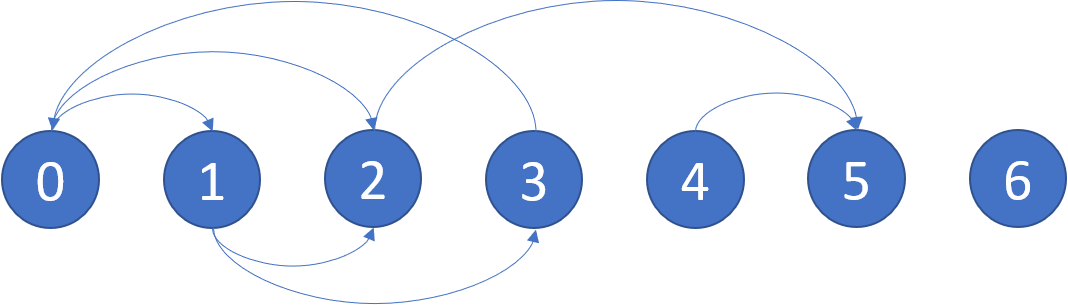
Input: graph = [[1,2],[2,3],[5],[0],[5],[],[]]
Output: [2,4,5,6]
Explanation: The given graph is shown above.
Nodes 5 and 6 are terminal nodes as there are no outgoing edges from either of them.
Every path starting at nodes 2, 4, 5, and 6 all lead to either node 5 or 6.
Example 2:
Input: graph = [[1,2,3,4],[1,2],[3,4],[0,4],[]]
Output: [4]
Explanation:
Only node 4 is a terminal node, and every path starting at node 4 leads to node 4.
Constraints:
n == graph.length1 <= n <= 1040 <= graph[i].length <= n0 <= graph[i][j] <= n - 1graph[i]is sorted in a strictly increasing order.- The graph may contain self-loops.
- The number of edges in the graph will be in the range
[1, 4 * 104].
Solutions
The point with zero out-degree is safe, and if a point can only reach the safe point, then it is also safe, so the problem can be converted to topological sorting.
JAVA
class Solution {
    private int[] color;
    private int[][] g;

    public List<Integer> eventualSafeNodes(int[][] graph) {
        int n = graph.length;
        color = new int[n];
        g = graph;
        List<Integer> ans = new ArrayList<>();
        for (int i = 0; i < n; ++i) {
            if (dfs(i)) {
                ans.add(i);
            }
        }
        return ans;
    }

    private boolean dfs(int i) {
        if (color[i] > 0) {
            return color[i] == 2;
        }
        color[i] = 1;
        for (int j : g[i]) {
            if (!dfs(j)) {
                return false;
            }
        }
        color[i] = 2;
        return true;
    }
}
C++
class Solution {
public:
    vector<int> color;

    vector<int> eventualSafeNodes(vector<vector<int>>& graph) {
        int n = graph.size();
        color.assign(n, 0);
        vector<int> ans;
        for (int i = 0; i < n; ++i)
            if (dfs(i, graph)) ans.push_back(i);
        return ans;
    }

    bool dfs(int i, vector<vector<int>>& g) {
        if (color[i]) return color[i] == 2;
        color[i] = 1;
        for (int j : g[i])
            if (!dfs(j, g)) return false;
        color[i] = 2;
        return true;
    }
};
PYTHON
class Solution:
    def eventualSafeNodes(self, graph):
        n = len(graph)
        color = [0] * n  # 0: unvisited, 1: visiting, 2: safe
        result = []

        def dfs(node):
            if color[node] > 0:
                return color[node] == 2
            color[node] = 1  # Mark as visiting
            for neighbor in graph[node]:
                if not dfs(neighbor):
                    return False
            color[node] = 2  # Mark as safe
            return True

        for i in range(n):
            if dfs(i):
                result.append(i)

        return result
Comments
Post a Comment