2116. Check if a Parentheses String Can Be Valid
A parentheses string is a non-empty string consisting only of '(' and ')'. It is valid if any of the following conditions is true:
- It is
(). - It can be written as
AB(Aconcatenated withB), whereAandBare valid parentheses strings. - It can be written as
(A), whereAis a valid parentheses string.
You are given a parentheses string s and a string locked, both of length n. locked is a binary string consisting only of '0's and '1's. For each index i of locked,
- If
locked[i]is'1', you cannot changes[i]. - But if
locked[i]is'0', you can changes[i]to either'('or')'.
Return true if you can make s a valid parentheses string. Otherwise, return false.
Example 1:
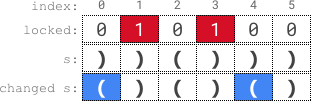
Input: s = "))()))", locked = "010100"
Output: true
Explanation: locked[1] == '1' and locked[3] == '1', so we cannot change s[1] or s[3].
We change s[0] and s[4] to '(' while leaving s[2] and s[5] unchanged to make s valid.
Example 2:
Input: s = "()()", locked = "0000"
Output: true
Explanation: We do not need to make any changes because s is already valid.
Example 3:
Input: s = ")", locked = "0"
Output: false
Explanation: locked permits us to change s[0].
Changing s[0] to either '(' or ')' will not make s valid.
Constraints:
n == s.length == locked.length1 <= n <= 105s[i]is either'('or')'.locked[i]is either'0'or'1'.
C++
class Solution {
public:
    bool canBeValid(string s, string locked) {
        int n = s.size();
        if (n & 1) {
            return false;
        }
        int x = 0;
        for (int i = 0; i < n; ++i) {
            if (s[i] == '(' || locked[i] == '0') {
                ++x;
            } else if (x) {
                --x;
            } else {
                return false;
            }
        }
        x = 0;
        for (int i = n - 1; i >= 0; --i) {
            if (s[i] == ')' || locked[i] == '0') {
                ++x;
            } else if (x) {
                --x;
            } else {
                return false;
            }
        }
        return true;
    }
};
JAVA
class Solution {
    public boolean canBeValid(String s, String locked) {
        int n = s.length();
        if (n % 2 == 1) {
            return false;
        }
        int x = 0;
        for (int i = 0; i < n; ++i) {
            if (s.charAt(i) == '(' || locked.charAt(i) == '0') {
                ++x;
            } else if (x > 0) {
                --x;
            } else {
                return false;
            }
        }
        x = 0;
        for (int i = n - 1; i >= 0; --i) {
            if (s.charAt(i) == ')' || locked.charAt(i) == '0') {
                ++x;
            } else if (x > 0) {
                --x;
            } else {
                return false;
            }
        }
        return true;
    }
}
PYTHON
class Solution:
    def canBeValid(self, s: str, locked: str) -> bool:
        n = len(s)
        if n % 2 != 0:
            return False

        open_count = 0
        for i in range(n):
            if s[i] == '(' or locked[i] == '0':
                open_count += 1
            elif open_count > 0:
                open_count -= 1
            else:
                return False

        close_count = 0
        for i in range(n - 1, -1, -1):
            if s[i] == ')' or locked[i] == '0':
                close_count += 1
            elif close_count > 0:
                close_count -= 1
            else:
                return False

        return True
Comments
Post a Comment