1462. Course Schedule IV
There are a total of numCourses courses you have to take, labeled from 0 to numCourses - 1. You are given an array prerequisites where prerequisites[i] = [ai, bi] indicates that you must take course ai first if you want to take course bi.
- For example, the pair
[0, 1]indicates that you have to take course0before you can take course1.
Prerequisites can also be indirect. If course a is a prerequisite of course b, and course b is a prerequisite of course c, then course a is a prerequisite of course c.
You are also given an array queries where queries[j] = [uj, vj]. For the jth query, you should answer whether course uj is a prerequisite of course vj or not.
Return a boolean array answer, where answer[j] is the answer to the jth query.
Example 1:
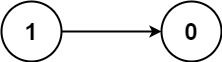
Input: numCourses = 2, prerequisites = [[1,0]], queries = [[0,1],[1,0]]
Output: [false,true]
Explanation: The pair [1, 0] indicates that you have to take course 1 before you can take course 0.
Course 0 is not a prerequisite of course 1, but the opposite is true.
Example 2:
Input: numCourses = 2, prerequisites = [], queries = [[1,0],[0,1]]
Output: [false,false]
Explanation: There are no prerequisites, and each course is independent.
Example 3:
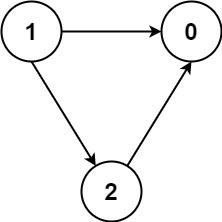
Input: numCourses = 3, prerequisites = [[1,2],[1,0],[2,0]], queries = [[1,0],[1,2]]
Output: [true,true]
Constraints:
2 <= numCourses <= 1000 <= prerequisites.length <= (numCourses * (numCourses - 1) / 2)prerequisites[i].length == 20 <= ai, bi <= n - 1ai != bi- All the pairs
[ai, bi]are unique. - The prerequisites graph has no cycles.
1 <= queries.length <= 1040 <= ui, vi <= n - 1ui != vi
JAVA
class Solution {
    public List<Boolean> checkIfPrerequisite(int n, int[][] prerequisites, int[][] queries) {
        boolean[][] f = new boolean[n][n];
        for (var p : prerequisites) {
            f[p[0]][p[1]] = true;
        }
        for (int k = 0; k < n; ++k) {
            for (int i = 0; i < n; ++i) {
                for (int j = 0; j < n; ++j) {
                    f[i][j] |= f[i][k] && f[k][j];
                }
            }
        }
        List<Boolean> ans = new ArrayList<>();
        for (var q : queries) {
            ans.add(f[q[0]][q[1]]);
        }
        return ans;
    }
}
C++
class Solution {
public:
    vector<bool> checkIfPrerequisite(int n, vector<vector<int>>& prerequisites, vector<vector<int>>& queries) {
        bool f[n][n];
        memset(f, false, sizeof(f));
        for (auto& p : prerequisites) {
            f[p[0]][p[1]] = true;
        }
        for (int k = 0; k < n; ++k) {
            for (int i = 0; i < n; ++i) {
                for (int j = 0; j < n; ++j) {
                    f[i][j] |= (f[i][k] && f[k][j]);
                }
            }
        }
        vector<bool> ans;
        for (auto& q : queries) {
            ans.push_back(f[q[0]][q[1]]);
        }
        return ans;
    }
};
PYTHON
class Solution:
    def checkIfPrerequisite(self, n, prerequisites, queries):
        # Create a boolean matrix for prerequisite relationships
        f = [[False] * n for _ in range(n)]

        # Populate the matrix with direct prerequisites
        for u, v in prerequisites:
            f[u][v] = True

        # Use Floyd-Warshall to find transitive prerequisites
        for k in range(n):
            for i in range(n):
                for j in range(n):
                    f[i][j] |= f[i][k] and f[k][j]

        # Answer each query based on the matrix
        return [f[u][v] for u, v in queries]
Comments
Post a Comment